Mud is not a texture: how Mudora simulates 8 terrain surfaces
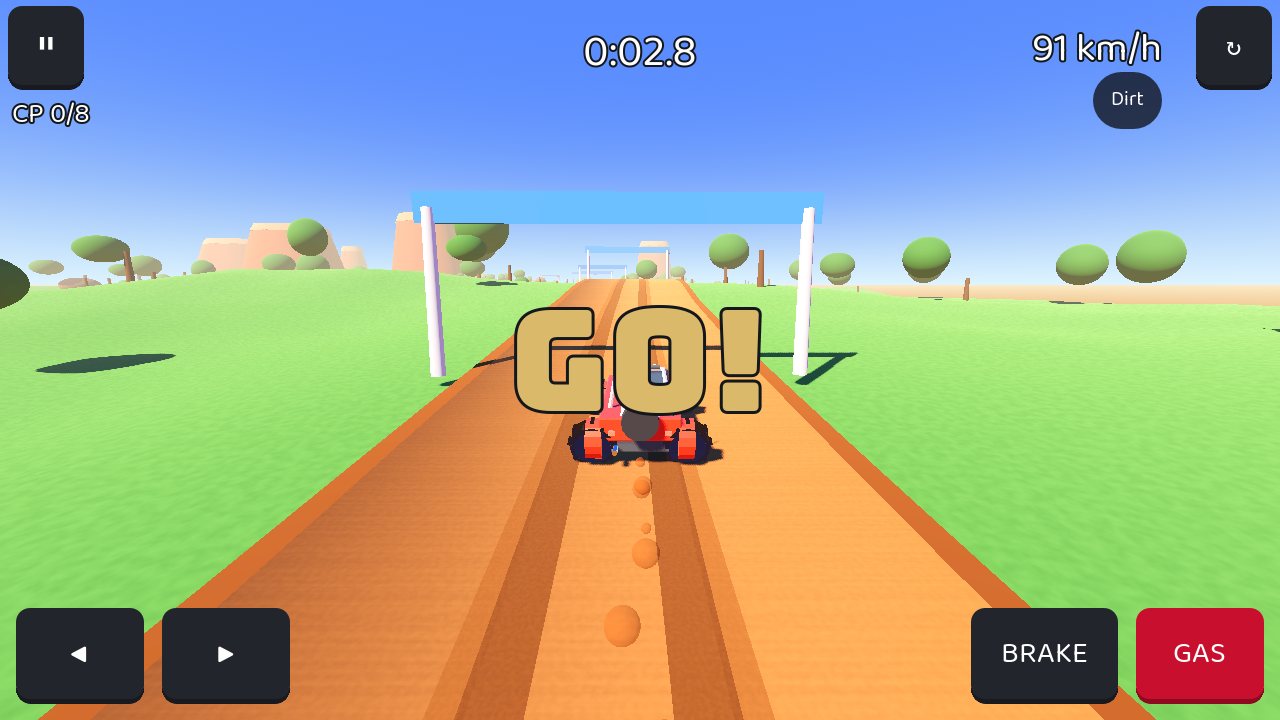
The core promise of Mudora is simple: the ground is a mechanic. Here's how it actually works under the hood — no marketing fog, real numbers from the build.
Four numbers per surface
Every surface in the game is defined by four physical parameters:
- Grip — multiplies each tire's friction. Asphalt is 1.0; wet mud drops to 0.42; water crossings bottom out at 0.35.
- Drag — a sinking force that pulls against your velocity. Sand and mud eat momentum even at full throttle.
- Engine loss — deep surfaces bog the drivetrain down. In mud your engine delivers only 62% of its force.
- Bump — high-frequency chassis kicks. Gravel rattles, boulder fields hammer.
Per wheel, not per car
The important part: these numbers are sampled under each wheel independently, every physics tick. Straddle the edge of a mud pit and your left wheels grip while your right wheels spin — the truck genuinely pulls sideways, and correcting it is on you. Cross a river at an angle and you feel the front axle slow before the rear. That asymmetry is what makes offroad driving read as real, even in a stylized world.
Trucks bend the rules
Each truck adds surface bonuses on top: the MUD KING gets +1.1 grip on mud — more than doubling the base 0.42 — which is why it swims where others sink. This is the entire monetization philosophy in one mechanic: specialists change where you're fast, never whether you can win.
The details you feel but don't see
- Engine force falls off near top speed like a real CVT — no infinite acceleration.
- Steering range narrows with speed for stability on rough trails.
- Airborne trucks self-level slightly so jumps land on wheels, not roofs.
- Flip your rig for 2.5 seconds and it auto-resets to the last checkpoint.
- Skidmarks are real: lose traction, brake hard or drift and the trail remembers — up to 512 marks stay on the ground behind you.
Why stylized?
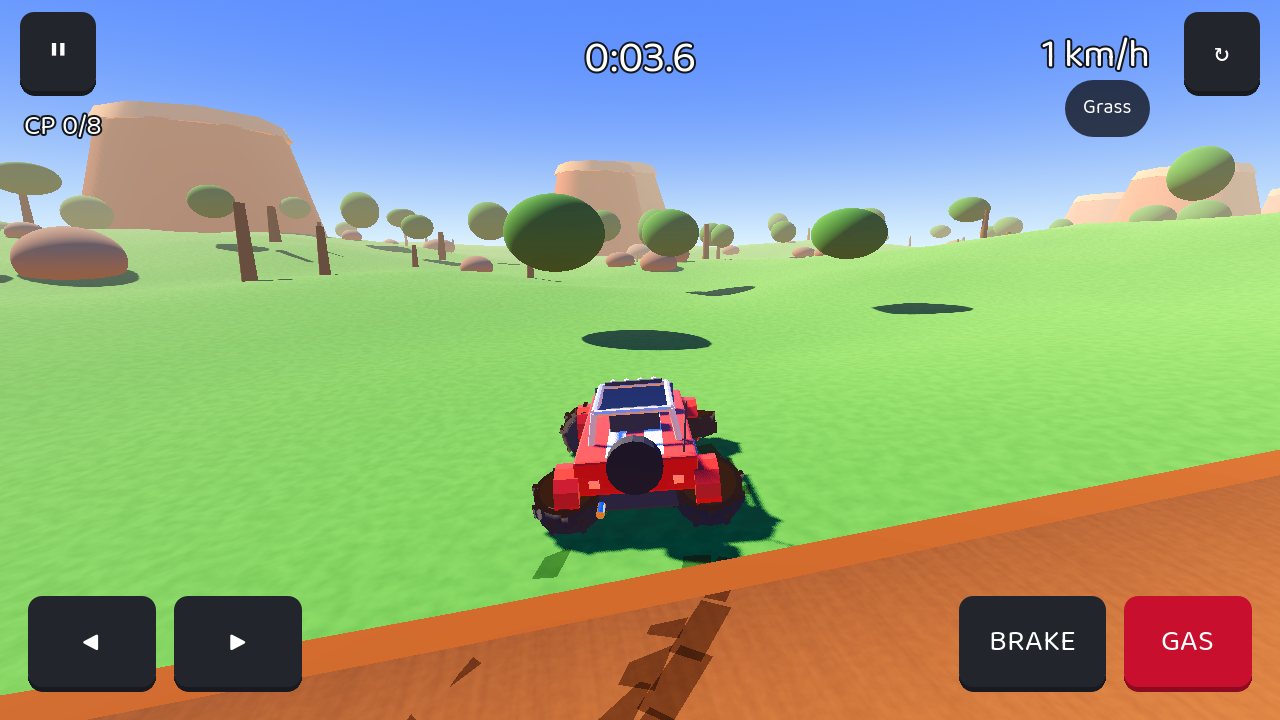
Because honesty beats photorealism on a phone. Saturated colors and chunky trucks read instantly at 6 inches wide, and a clean art style leaves the GPU budget where it belongs: on physics ticking at a rock-solid 60 Hz.
← All posts